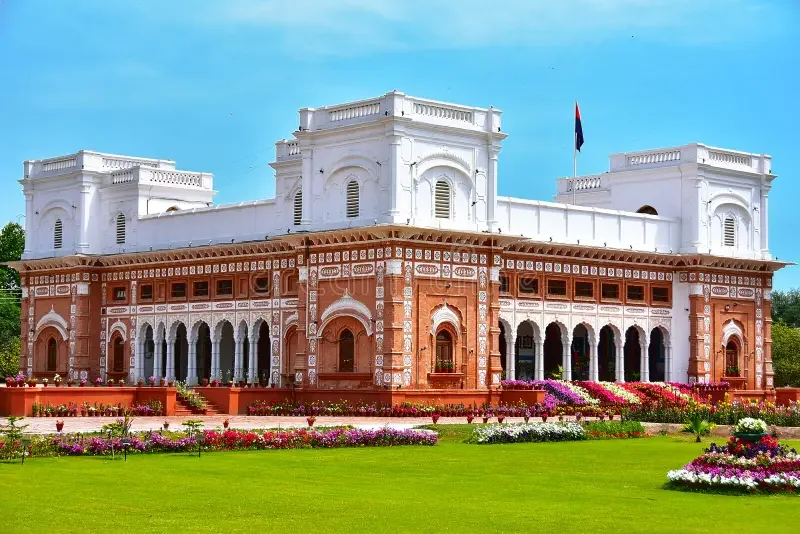
There's a palace in Bahawalpur that sits behind military gates, surrounded by manicured gardens, in what might be the best-preserved Nawab-era building in the entire city. Most Bahawalpuris know it exists. Almost none have been inside. That's Nishat Mahal — the "Palace of Delight" — and it's been locked behind Army control since 1966.
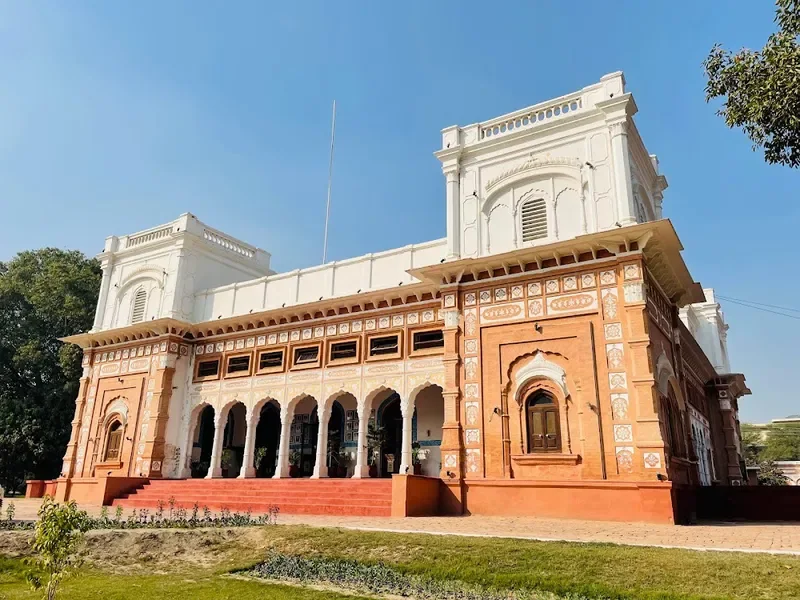
I've walked past the Bahawalgarh Complex perimeter more times than I can count. You catch glimpses of the red-and-white facade through the trees, and every time it stops you. The building looks like it was designed by three different architects from three different civilizations who somehow agreed on a single blueprint. Corinthian columns next to Mughal domes next to Sikh-style windows — it shouldn't hold together, but it does. And it looks extraordinary.
The frustrating part? You can't just walk up and explore it. But that doesn't mean there isn't a story worth telling. Between the Wikipedia documentation, the Punjab Tourism Development Corporation's listing, and the Department of Archaeology and Museums records, we've got enough verified detail to piece together what makes this palace remarkable.
What Nishat Mahal actually is
Nishat Mahal is an early 20th-century royal residence inside the Bahawalgarh Palace Complex in Bahawalpur, Punjab. It was built as part of a cluster of four palaces — alongside Darbar Mahal, Farrukh Mahal, and Gulzar Mahal — that together formed the administrative and residential heart of the Princely State of Bahawalpur in its final decades.
The name "Nishat" translates loosely as "delight" or "pleasure." TDCP describes it as the residence for the royal women of the Nawab's household — specifically the wives and female family members other than the queen. Think of it as the domestic wing of a much larger royal compound. While Darbar Mahal handled state business and formal audiences, Nishat Mahal was where the family actually lived.
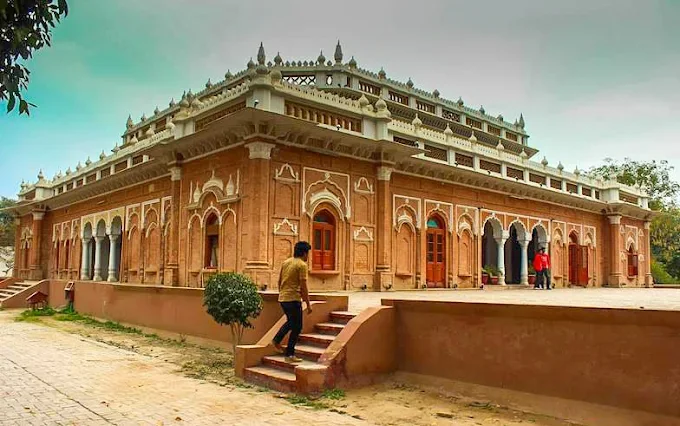
It's a two-story structure built from red brick with white stucco banding, sitting on a raised platform that extends outward on all four sides. The Department of Archaeology and Museums describes it as "influenced by European design," which is accurate but doesn't capture the full picture. This building is a collision point for at least three distinct architectural traditions — and we'll get into that shortly.
Quick reference
Names: Nishat Mahal, Nishat Palace, Palace of Delight
Built by: Nawab Muhammad Bahawal Khan V (r. 1899–1907)
Construction: 1905–1911
Location: Bahawalgarh Palace Complex, Bahawalpur Cantonment
Material: Red brick, white stucco, marble accents
Style: Indo-Saracenic and Victorian eclectic
Current use: Pakistan Army administrative facility (closed to public)
The history: 1905–1911
The timeline here is well documented. On May 19, 1904, construction plans for a new palace complex were formally approved. The following year, work began on Nishat Mahal under the direction of Nawab Muhammad Bahawal Khan V — the last active ruling Nawab of Bahawalpur state.
Bahawal Khan V wasn't just building a house. He was building a statement. By 1905, the princely states of British India were locked in what amounted to an architecture arms race. Hyderabad had Falaknuma Palace. Mysore had its palace rebuilt in Indo-Saracenic style. Baroda was constructing Lakshmi Vilas Palace. Each ruler was proving his legitimacy and modernity through buildings that blended European and local styles. Bahawalpur's answer was the Bahawalgarh Complex — and Nishat Mahal was its principal domestic residence.
Here's where the story takes a turn. Bahawal Khan V died in 1907, before the complex was finished. His successor, Nawab Sadiq Muhammad Khan V, was sent to England for education. According to local accounts, the partially built palaces were considered unlucky — associated with the previous Nawab's death during construction. Work stalled for years.
It wasn't until Sadiq Muhammad Khan returned from Britain, was formally crowned at Noor Mahal, and took up governance that the construction resumed. Nishat Mahal and the other palaces were finally completed in 1911. The total construction period: six years, interrupted by a change of ruler and a detour through England.
The post-independence handover
After Pakistan's creation in 1947, the Nawab offered the Bahawalgarh Complex for government use during the new country's financial difficulties. The last Nawab of Bahawalpur was known for his generosity to the new state — his contributions to Pakistan's early treasury are well documented in local histories. The complex served as offices for the provincial government and the Prime Minister of Bahawalpur State from 1932 to 1955.
In 1966, the Pakistan Army took full control of the site. The 35th Infantry Division established its headquarters here, and the Bahawalpur Regimental Centre now operates from the complex. The Abbasi heirs still technically own the property under a lease arrangement with the federal government — a detail that occasionally surfaces in legal disputes.
Architecture: where three traditions collide
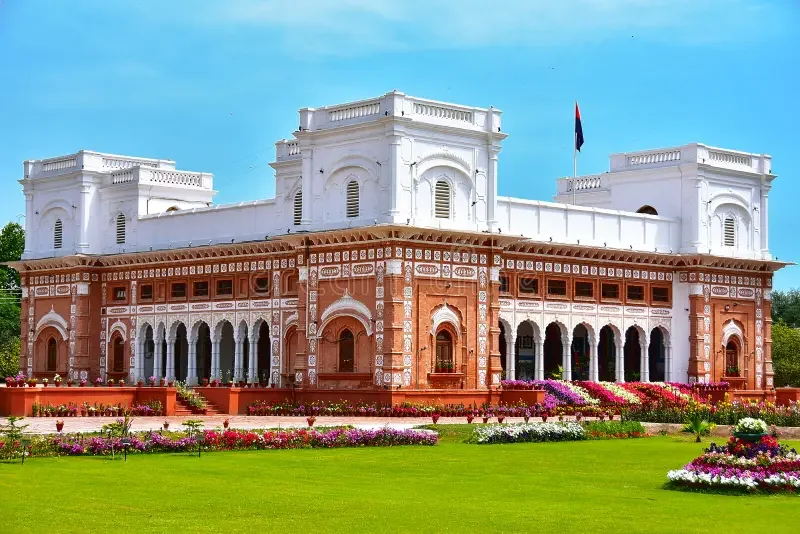
This is where Nishat Mahal gets genuinely interesting. The palace isn't just "European influenced" or "Mughal style" — it's a deliberate, self-conscious hybrid that draws from at least three distinct architectural traditions and somehow makes them coexist on a single facade.
The European layer
The most immediately visible elements are European. Corinthian balustrades line the upper level. The central entrance features a triple-arched doorway fronted by a British-inspired marble fountain. Vaulted ceilings inside follow European structural principles. The overall symmetry — a raised platform extending equally on all four sides with a central hall plan — reflects the neoclassical planning that British architects had been exporting across the subcontinent since the 1850s.
The Islamic and Mughal layer
Then you look closer. Multi-foiled arches with intricate stucco tracery frame the windows and doorways — a distinctly Islamic decorative vocabulary. Fret-worked jali screens filter light into interior spaces, creating the play of shadow that defines Mughal residential architecture. And crowning the roofline, Mughal-style chattris (elevated domed kiosks) punctuate the skyline. These aren't decorative afterthoughts. They're integrated into the building's structural rhythm.
The Sikh influence
Here's the layer most people miss. Wikipedia's architectural analysis identifies "Sikh-period window compositions" in the facade. This makes historical sense — Bahawalpur borders the former Sikh Empire's territory, and the region's builders would've absorbed Sikh architectural vocabularies through proximity. The octagonal tower forms and certain window groupings carry echoes of Sikh-era buildings in Lahore and Amritsar. It's a regional fingerprint that sets Bahawalpur's palaces apart from Indo-Saracenic buildings in, say, Hyderabad or Mysore.
The interior
We know less about the interior, since public access has been restricted for decades. What documentation exists describes fresco paintings across the walls and lacquered timber ceilings — techniques that were standard in high-end Nawab-era residential buildings. The DOAM listing confirms that paintings and original furniture from the Nawab's period survive inside.
There's a catch, though. During army restoration work in 2004 and 2007, many of the original frescoes were over-painted. Whether this constitutes preservation or damage depends on who you ask. The structure is intact. The original decorative scheme? Partially lost under newer paint.
Architectural DNA: three traditions in one building
European: Corinthian balustrades, marble fountain, triple-arched entrance,
vaulted ceilings, symmetrical platform plan
Islamic/Mughal: Multi-foiled arches, stucco tracery, jali screens, chattris on
the roofline
Sikh regional: Octagonal principal chambers, specific window compositions,
balustered parapets
Materials: Red brick with white stucco bands — the signature Bahawalpur palette
you'll see repeated at Darbar Mahal next door
Inside the Bahawalgarh Palace Complex
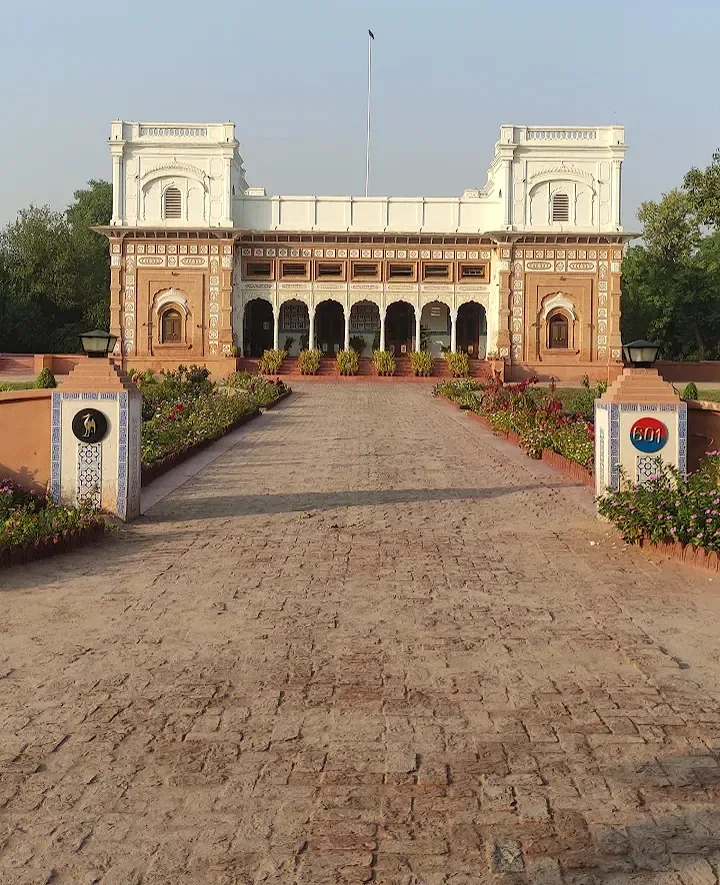
You can't really understand Nishat Mahal without understanding the compound it sits in. The Bahawalgarh Palace Complex covers roughly 75 acres of walled grounds in Bahawalpur's cantonment area, near Jhangwali Road and not far from SE College Road and Farid Gate Road.
The four palaces
Nishat Mahal is just one piece. The complex contains four palaces, each built for a different purpose:
- Darbar Mahal — the largest of the four. Originally called Mubarak Mahal, it served as the Nawab's formal court and state high court. It's the one most visitors are aware of, partly because it houses a small museum with Nawab-era artifacts, portraits, coins, stamps, military medals, and the famous faryadi (petition) bell cast by Gillett & Johnston in Croydon, England, gifted to the Nawab in 1906.
- Nishat Mahal — the domestic residence for the royal women's household. Smaller than Darbar Mahal, positioned directly adjacent to it.
- Farrukh Mahal — the third companion palace, completing the trio that was formally approved in 1904.
- Gulzar Mahal — the fourth palace in the complex, less documented than the other three.
Beyond the palaces
The compound also includes Sadiq Mosque (the royal mosque), a baradari pavilion with 28 arched doorways on each side, an Italian marble fountain commissioned in 1906, and expansive gardens still maintained to this day. The lamp posts and original landscape design around Nishat Mahal are specifically noted by the DOAM as "worth-seeing" — a rare editorial comment from an archaeological survey.
The Darbar Mahal baradari now contains a small museum showcasing the Bahawalpur State's history. It's got an eclectic collection: postage stamps and coins issued by the state, military decorations including the Sutlej Medal and WWII campaign medals, uniforms worn by the Nawab's personal guard, and photographs of Nawab Sadiq Muhammad Khan V with Quaid-e-Azam Muhammad Ali Jinnah, Fatima Jinnah, Liaquat Ali Khan, and various viceroys.
The Pelican — the state emblem of Bahawalpur — appears throughout the complex. It's said the Nawab adopted it because the pelican would rather sacrifice itself than let its young go hungry. You'll find pelican motifs on official seals, and three live pelicans still roam the grounds around Darbar Mahal.
The Army years and why you can't walk in
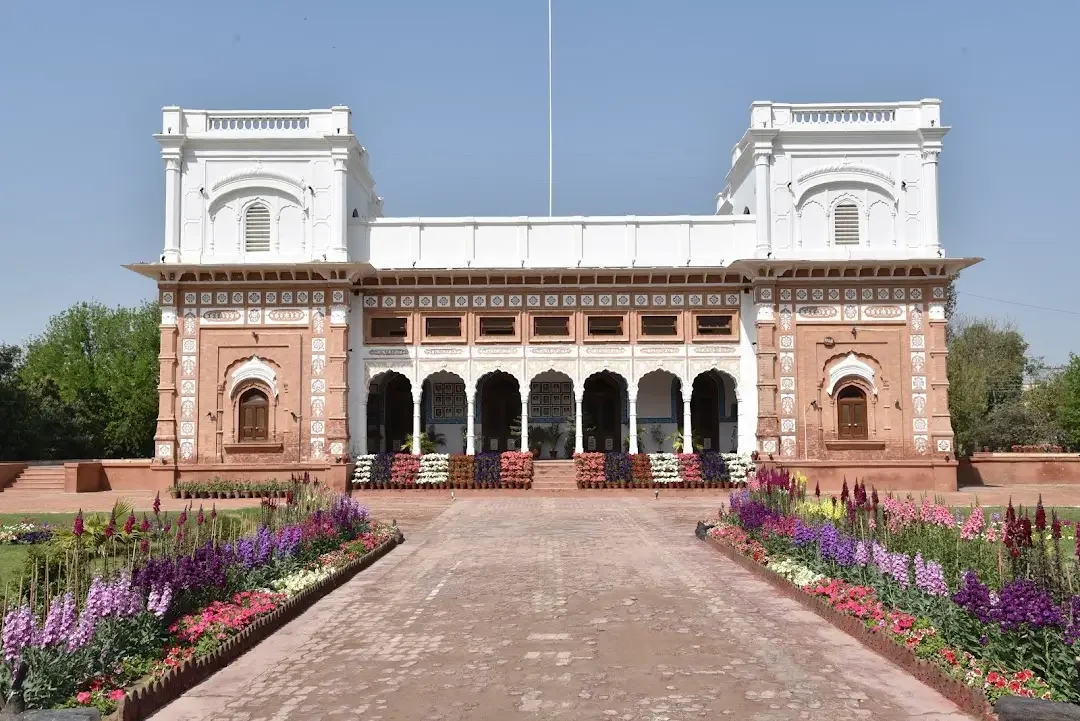
Let's address the elephant in the room. Nishat Mahal — along with the entire Bahawalgarh Complex — has been under Pakistan Army control since 1966. The 35th Infantry Division and Bahawalpur Regimental Centre operate from the site. That means it's a functioning military installation, not a heritage museum.
Public access is strictly restricted. TDCP's official listing, updated as of December 2025, states plainly: "entry requires special permission from military authorities, which is rarely granted." That's not a diplomatic understatement. Tourists essentially don't get in. Occasional ceremonial visits and VIP tours happen, but there's no regular visiting schedule and no ticket counter.
The preservation paradox
Here's what's complicated about this. The buildings are in excellent condition. The gardens are immaculate. The lamp posts and original landscape features survive. If you've visited Noor Mahal before and after its restoration, you've seen what happens to Bahawalpur's palaces when they get proper maintenance. The Army has, by virtue of actually using these buildings, kept them from deteriorating the way abandoned heritage buildings across Pakistan routinely do.
Whether military control is the right long-term model for heritage preservation is a debate that locals have been having for decades. The buildings survive. The public doesn't get to see them. Both things are true, and neither fully resolves the question.
Legal status
The DOAM lists Nishat Mahal's ownership as "Private" and its legal status as "Not Protected." That means it isn't registered under the Antiquities Act — a gap that heritage advocates have raised repeatedly. The Abbasi family retains ownership under a lease arrangement with the federal government, but practical control rests entirely with the military.
How to see Nishat Mahal today
I won't pretend you can just show up and tour the place. But there are ways to experience it — and to build a Bahawalpur heritage itinerary that includes everything you can access.
What's actually possible
- Exterior views: You can see parts of the palace from surrounding roads and the complex's perimeter. The red-and-white facades are visible through the treeline, particularly along the approaches near Jhangwali Road.
- Special permission: If you have a genuine research or media purpose, you can apply through military channels. This isn't a standard tourist option, but it's worth noting for academics or journalists working on Bahawalpur heritage.
- Darbar Mahal museum: The museum inside the baradari near Darbar Mahal is occasionally accessible — ask locally about current arrangements. It's the closest you can legally get to the complex's interior.
- Photography: Exterior shots from public roads are generally fine. Don't attempt to photograph military installations or personnel.
Build the full palace route instead
Rather than treating Nishat Mahal as a standalone destination, fit it into a complete Bahawalpur royal palaces route. Here's what you can actually visit:
- Noor Mahal — fully restored, open to visitors, and the most photogenic palace in the city. This is your primary palace experience in Bahawalpur.
- Darbar Mahal — limited exterior access, but worth seeing for the facade and any museum availability.
- Nishat Mahal — exterior views from surrounding roads.
- Farrukh Mahal — the least documented of the four, also within the restricted complex.
Round out the trip with desert heritage at the Abbasi Mosque and Derawar Fort in Cholistan. And don't leave Bahawalpur without eating properly — check the Bahawalpur food guide for where locals actually go.
When to go
October through April. Bahawalpur sits in southern Punjab where summer temperatures routinely cross 40°C and can push past 50°C in extreme conditions. TDCP recommends the same October–April window for Nishat Mahal specifically. Even walking around a palace exterior in June heat is brutal. Winter mornings give you the best light for exterior photography and the most comfortable conditions for exploring the city's heritage sites on foot.
Getting to Bahawalpur
By air: Bahawalpur Airport has limited domestic flights — check current
schedules
By train: Bahawalpur Junction connects to Lahore, Multan, and Karachi via
Pakistan Railways
By road: About 5–6 hours from Lahore via N-5 highway, or 2 hours from
Multan
Within the city: Hire a local car or rickshaw for the palace route. The
Bahawalgarh Complex is in the cantonment area — well-known to every driver in town.
Frequently asked questions
Can you visit Nishat Mahal?
Not freely. Nishat Mahal sits inside a restricted military zone — the Bahawalgarh Palace Complex has been under Pakistan Army control since 1966. Entry requires special permission from military authorities, which is rarely granted to tourists. You can view the exterior from surrounding roads and the complex's perimeter.
When was Nishat Mahal built?
Construction started in 1905 under Nawab Muhammad Bahawal Khan V and was completed in 1911. The plans for Nishat Mahal and its companion palaces were approved on May 19, 1904. Building paused after the Nawab's death in 1907 and resumed under his successor.
What architectural style is Nishat Mahal?
Indo-Saracenic and Victorian eclectic. The palace blends Corinthian columns and balustrades with multi-foiled Islamic arches, Mughal-style chattris, and Sikh-period window compositions — all built in red brick with white stucco banding. It's a deliberate hybrid that reflects the Nawabs' dual allegiance to local traditions and British modernity.
Who built Nishat Mahal?
Nawab Muhammad Bahawal Khan V, the last ruling Nawab of the Princely State of Bahawalpur. He commissioned it as part of a larger palace-building initiative that included Darbar Mahal, Farrukh Mahal, and Gulzar Mahal within the Bahawalgarh compound.
What is the Bahawalgarh Palace Complex?
A 75-acre walled compound in Bahawalpur's cantonment area containing four palaces, a royal mosque, a baradari pavilion, and extensive gardens. It was the primary administrative and residential seat of the Bahawalpur princely state in its final decades. The entire complex has been under Army control since 1966.
Why does the Pakistan Army control Nishat Mahal?
After independence in 1947, the Nawab offered the complex for government use during Pakistan's early financial difficulties. Government offices operated from the site for nearly two decades. In 1966, the Army's 35th Infantry Division took full control. The Abbasi heirs still own the property under a lease arrangement, but practical authority rests with the military.
What's the best time to visit Bahawalpur for heritage tourism?
October through April. Summer temperatures in Bahawalpur regularly exceed 40°C, making outdoor sightseeing uncomfortable at best. Winter months offer mild weather between 20–30°C — ideal for exploring the palaces, old city architecture, and desert sites like Derawar Fort.
Related articles