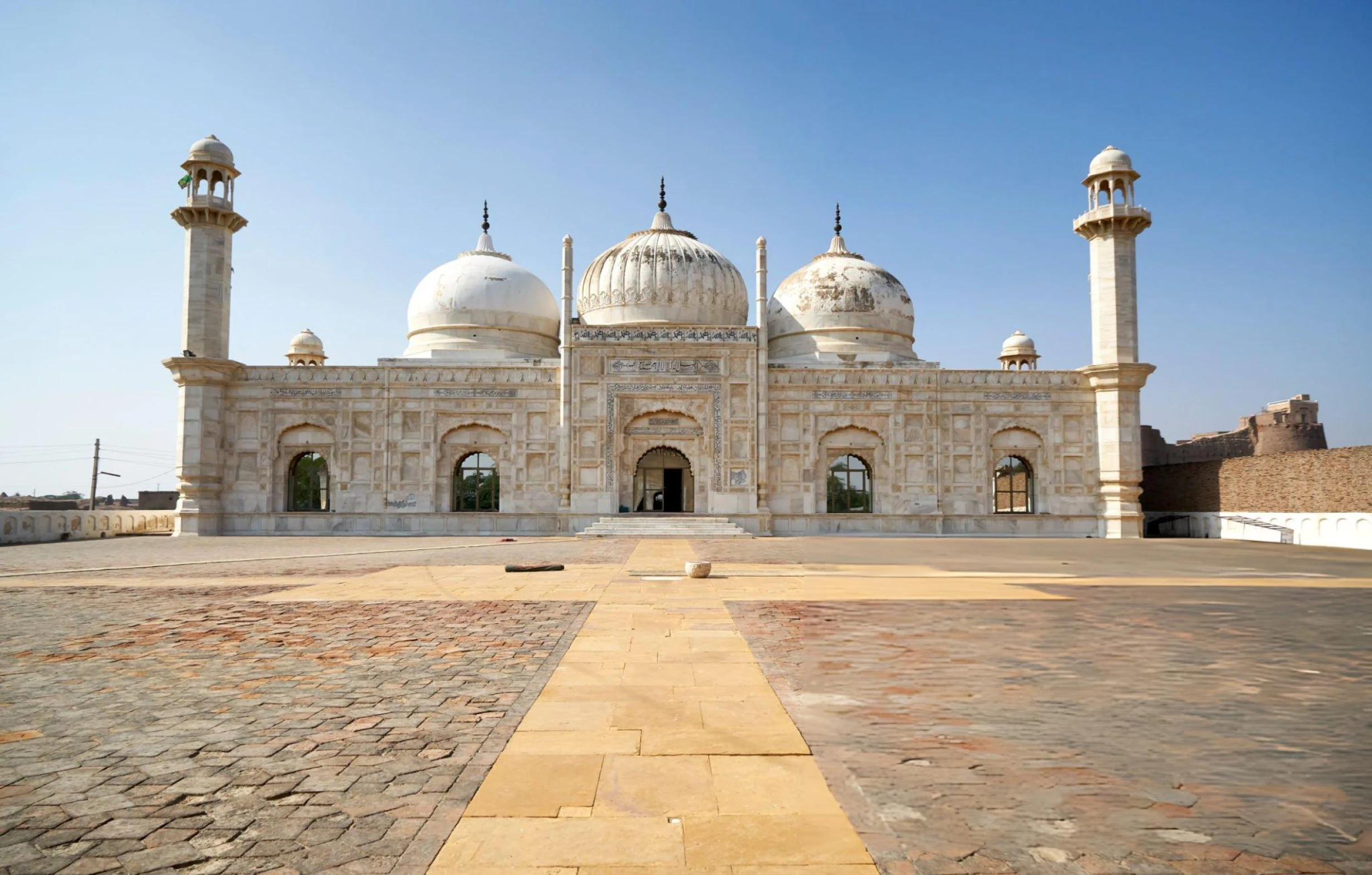
There's a mosque in the Cholistan Desert that most people outside Bahawalpur have never heard of. It sits about 280 meters from Derawar Fort, built entirely from polished white marble, with three domes that catch desert light in a way that makes you stop walking and just look. That's the Abbasi Mosque — also called the Derawar Mosque, Shahi Mosque, or Jamia Masjid-e-Abbasi, depending on who you're talking to.
I've been out here enough times to know that most visitors treat this mosque as an afterthought. They drive hours into the desert for the fort, take their photos of the 40 bastions, and barely glance at the marble structure sitting a short walk away. That's a mistake. The Abbasi Mosque is, in some ways, more impressive than the fort itself — and it's in far better condition.
What the Abbasi Mosque actually is
The Abbasi Mosque is a 19th-century congregational mosque that Nawab Bahawal Khan III commissioned during his rule over the Princely State of Bahawalpur (1825–1852). He didn't build it in the city. He built it in the desert, right beside the dynasty's ancestral fort and family tombs. That tells you something about what Derawar meant to the Abbasi rulers — it wasn't just a military outpost. It was their spiritual home.
The mosque was designed as a scaled replica of Delhi's Jama Masjid, the Shah Jahan-era congregational mosque that defined Mughal religious architecture. Using the same construction materials — white marble throughout — the Nawab was making a deliberate political statement: we are the rightful inheritors of the Mughal tradition in this part of the subcontinent.
Today it's still an active mosque. People pray here. That's easy to overlook when you read heritage descriptions, but it matters — this isn't a dead monument behind a fence. It's a living building that happens to be 175+ years old.
Quick reference
Names: Abbasi Mosque, Derawar Mosque, Shahi Mosque, Jamia Masjid-e-Abbasi
Built by: Nawab Bahawal Khan III (r. 1825–1852)
Location: 280m southeast of Derawar Fort, Yazman Tehsil, Cholistan Desert
Material: Polished white marble
Capacity: Approximately 10,000 worshippers
Status: Active mosque — still used for prayer
The history behind the mosque
You'll find conflicting dates if you dig into the sources. The dedicated architectural study on Asian Historical Architecture places construction at 1835. The Dawn newspaper's listing and Wikipedia cite 1849. Both dates fall within the reign of Nawab Bahawal Khan III, so the builder isn't disputed — just the exact year. I'll use the safe framing: the mosque was built in the mid-19th century, somewhere between 1835 and 1849.
That timeframe matters because of what was happening in the region. The Mughal Empire had shrunk to a shadow of itself — the emperor's authority barely reached beyond Delhi's walls. But Mughal architecture hadn't lost its power as a symbol. Across the princely states of the subcontinent, local rulers were still building in the Mughal idiom because it carried associations of empire, legitimacy, and divine authority.
Nawab Bahawal Khan III was particularly invested in that association. British gazetteers from the period describe him as "Sakhi Bahawal Khan" — "the Generous" — and note his cooperation during the Multan campaign. He wasn't building this mosque quietly. He was building it as a declaration: the Abbasi dynasty stands with the great builders, even in the middle of the desert.
Why Derawar and not Bahawalpur city?
This is the question that trips up first-time visitors. Why would you build a 10,000-capacity marble mosque 100+ kilometers from your capital, in the Cholistan Desert?
The answer is that Derawar wasn't just any fort. The Abbasi dynasty tombs are right next to the mosque. The Nawab's family maintained a substantial residence within the fortress walls. According to Dawn's reporting on Derawar, the Nawab visited every Thursday, held court with his entourage and lieutenants, stayed overnight, and attended Friday prayers at this mosque the next morning.
So this wasn't a vanity project in an empty desert. It was the weekly spiritual headquarters of the ruling family, built adjacent to their ancestors' graves. The location makes perfect sense once you understand that context.
Architecture and design
Let's talk about what makes this building remarkable on its own terms — not just as an adjunct to Derawar Fort.
The prayer hall
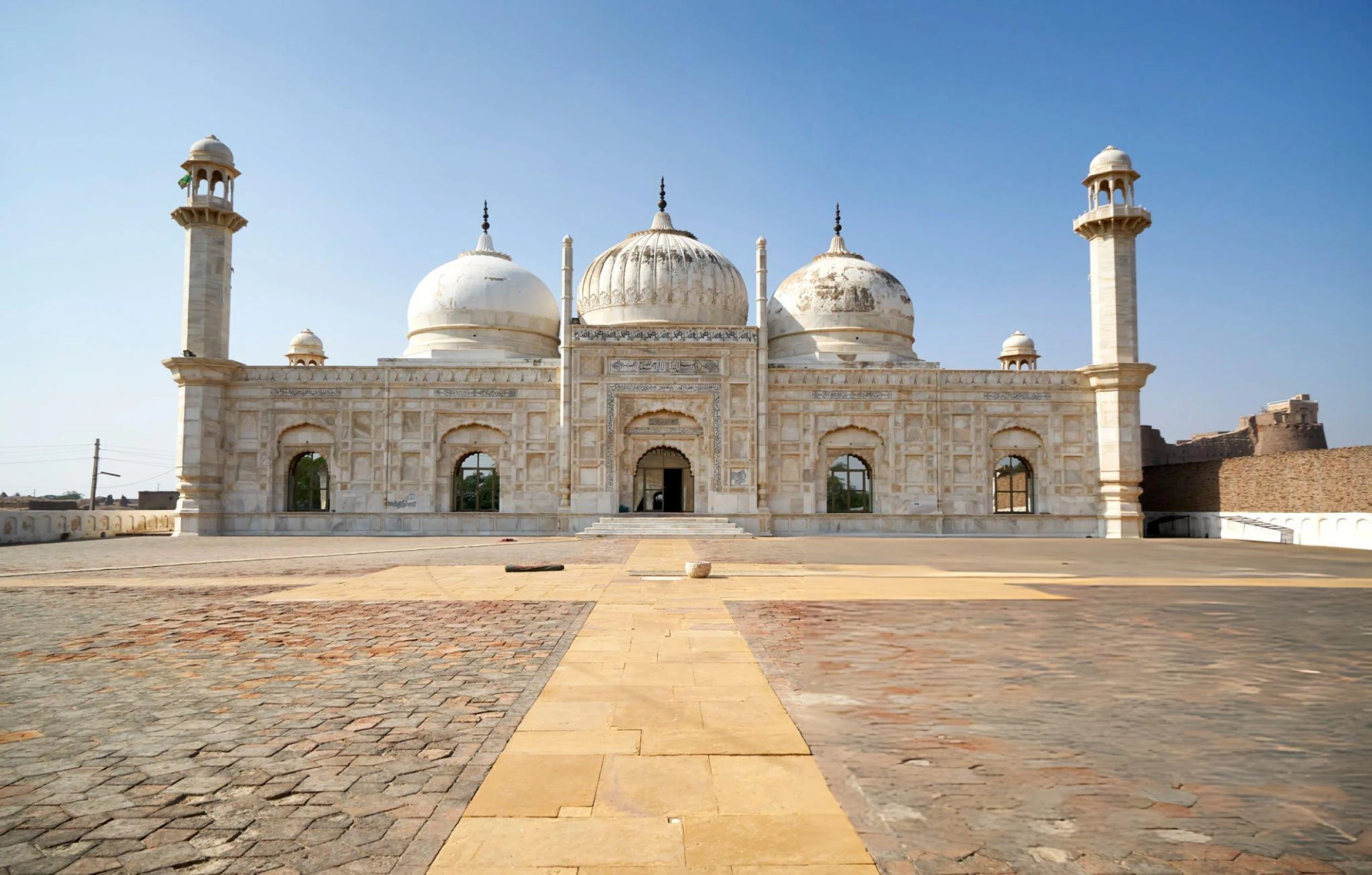
The mosque is a single-file, five-bay enfilade facing a vast open courtyard. The prayer hall stretches 39 meters long (128 feet) but is only 4.9 meters wide (16 feet). That narrow, elongated shape is a deliberate design choice from the Lodhi and early Mughal era — it maximizes the width of the qibla wall facing Mecca while keeping the structure manageable for desert construction.
Together, the paved courtyard and prayer hall can hold about 10,000 worshippers. That's an enormous capacity for a desert location, and it tells you how seriously the Nawabs treated state ceremonies conducted here.
Three marble domes
Three bulbous marble domes sit on high drums and extend distinctively into the sky — the same profile you'd recognize from Delhi's Jama Masjid. They're not hidden behind the roofline the way earlier congregational mosques handled domes (think Fatehpur Sikri). Instead, they dominate the surrounding dunes. On a clear desert day, you can see them from a remarkable distance across flat terrain.
The facade and calligraphy
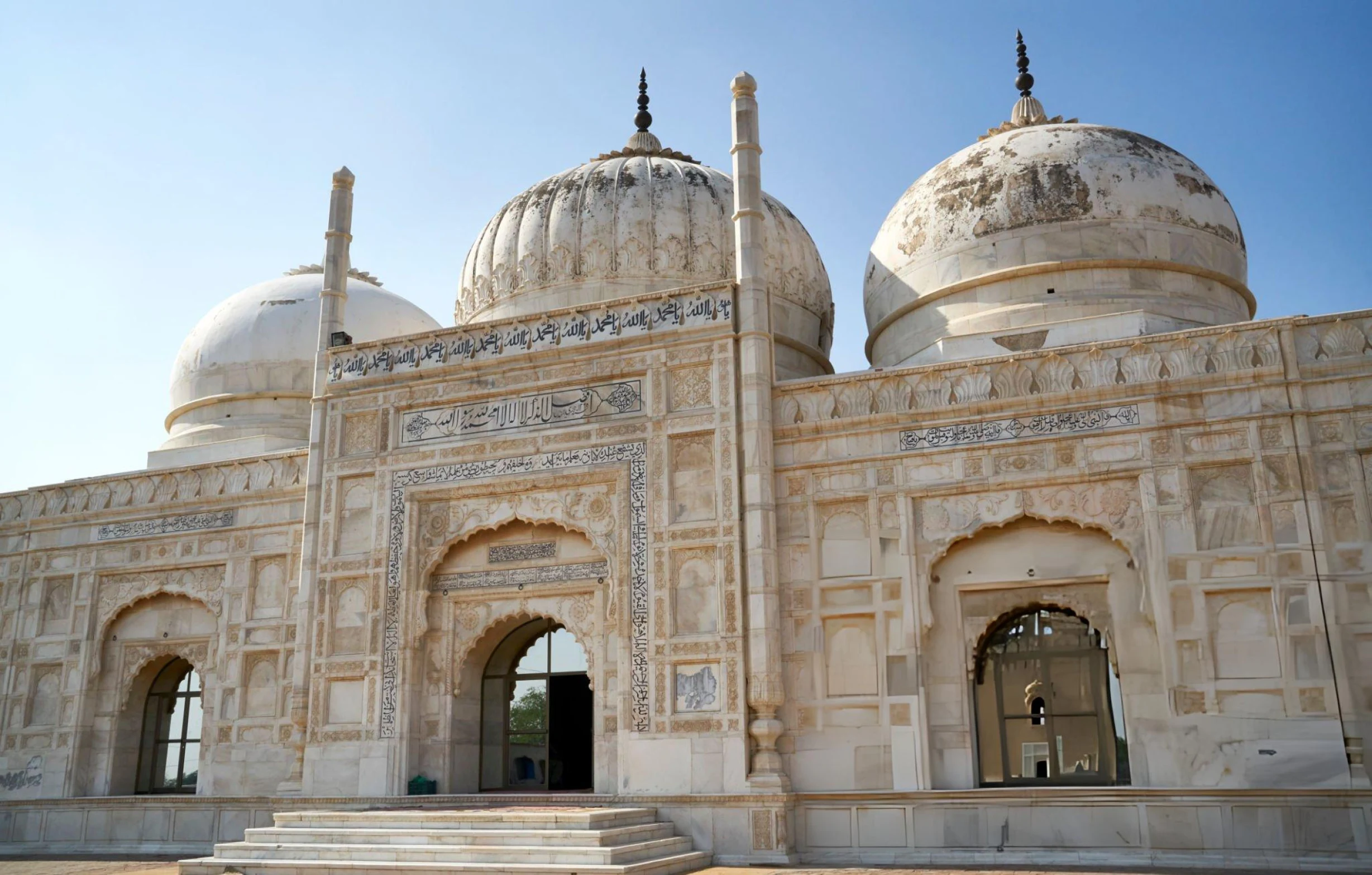
Two octagonal minarets anchor the corners — a motif that traces back to the Wazir Khan Mosque in Lahore and became standard for mid-century Jama Masjids across the region. Between them, the tri-arched facade has five openings filled with exquisite carved detail.
The central portal is the showpiece. Two nested cusped arches sit surrounded on three sides by a calligraphic frame containing the ninety-nine names of Allah and various Quranic verses. Additional panels stack above the inner archway. As a finishing touch — and I think this is my favorite detail — the flame-shaped merlons running along the cornice are signed with short repeating inscriptions: "Oh Allah, Oh Muhammad." It's the kind of detail you'd miss completely from a distance but can't unsee once someone points it out.
The jharokha — the rarest feature
Here's what makes architects and historians pay attention: the west facade — the qibla wall facing Mecca — has a jharokha balcony window. On the Indian subcontinent, the qibla wall of a mosque is almost never decorated. There's no reason for visitors to approach from that direction. But the Abbasi Mosque sits east of the fortress, meaning the west facade faces the fort itself.
The architects apparently decided the Nawab deserved something to look at as he walked from the palace toward the mosque. The jharokha marks the mihrab location and is accessible from inside. One theory suggests the imam would stand there to greet the Nawab as he emerged from the palace for Friday prayers. It's a possibly unique feature in subcontinental mosque architecture.
Architectural comparison: Abbasi Mosque vs. Delhi's Jama Masjid
Both feature a five-bay prayer hall, bulbous domes on drums, and twin minarets. The Abbasi Mosque uses the same marble construction but at a smaller scale. Its unique additions — the jharokha on the qibla wall and the flame-shaped inscribed merlons — are original departures from the Delhi template. The Delhi original was built for an emperor's capital; this version was built for a Nawab's desert stronghold.
The Derawar mosque complex
The Abbasi Mosque doesn't sit alone. Understanding the broader site helps you appreciate why the Nawabs chose this location — and why a visit here should include more than just the mosque.
Derawar Fort
The fort sits 280 meters to the northwest. Its 40 bastions rise 30 meters high and are visible across the desert from miles away. Originally built in 858 CE by Rai Jajja Bhati, it was renovated by the Abbasi rulers in 1732. If you're planning a visit, read the full Derawar Fort and Cholistan planning guide — access expectations need to stay flexible since the fort is technically private property of the Bahawalpur royal family.
The Nawab cemetery
Just east of the fort, you'll find the tombs of the Nawabs and their families. The most striking is an ornate domed marble mausoleum built for the last Nawab's English wife. These graves are the reason the mosque was built here — the Abbasi rulers wanted to pray near their ancestors. Most visitors walk through the cemetery quickly, but if heritage architecture is your thing, slow down and look at the stonework.
The Moti Masjid
There's also a smaller Pearl Mosque (Moti Masjid) in the area, part of the larger religious infrastructure the Nawabs maintained around Derawar. Between the fort, the Abbasi Mosque, the tombs, and the Moti Masjid, you're looking at a concentrated heritage cluster that tells one continuous story of dynastic power and patronage.
If you're building a broader itinerary around the royal palaces of Bahawalpur, the Derawar complex is where the desert chapter of that story plays out. The city chapter happens at Noor Mahal and Darbar Mahal.
How to visit the Abbasi Mosque
Getting here isn't hard, but it does require some planning. You can't just turn up in a sedan.
Getting there
From Bahawalpur, drive south to Ahmedpur East (about 50 km on paved road), then continue into the Cholistan Desert on unpaved tracks. The desert stretch takes 3–4 hours by 4WD. You'll want a local guide or driver who knows the tracks — this isn't marked highway territory. For the full route breakdown, check the Bahawalpur to Derawar road trip itinerary.
Most tour operators from Bahawalpur and Ahmedpur East include both Derawar Fort and the Abbasi Mosque in their standard desert tour. Don't try to make it a separate trip — they're 280 meters apart.
When to go
October through March. Full stop. Cholistan summers regularly push past 45°C, and standing in front of a white marble facade under that sun isn't tourism — it's punishment. Winter mornings give you the best photography light and the most comfortable temperatures for actually engaging with the architecture instead of rushing through it.
What to know before you go
- Dress modestly. This is an active mosque. Cover your shoulders and legs regardless of gender. Women should bring a headscarf.
- Remove shoes before entering the prayer hall.
- No entry fee for the mosque itself. Derawar Fort's interior requires permission from the Amir of Bahawalpur.
- Photography — exterior shots are generally fine. For interior photography, ask locally before assuming.
- Bring water and sun protection. There are no shops, cafes, or shade structures at the site.
- Phone signal is unreliable in Cholistan. Download offline maps before leaving Ahmedpur East.
- Budget half a day for the full Derawar complex — fort, mosque, tombs, and desert views.
If you're building a multi-day Bahawalpur trip, pair the Derawar/Cholistan day with a separate city heritage day covering Noor Mahal and the old city. And don't skip the food — the Bahawalpur food guide covers what's actually worth eating. For a nature contrast, Lal Suhanra National Park sits about 35 km east of the city.
Practical checklist
Vehicle: 4WD only beyond Ahmedpur East
Guide: Strongly recommended (hire from Ahmedpur East or Bahawalpur)
Season: October–March
Time needed: 30–45 min for the mosque; half-day for the full Derawar
complex
Essentials: Water, sunscreen, modest clothing, offline maps, charged phone
Combine with: Derawar Fort, Nawab tombs, Moti Masjid
Why it matters for Bahawalpur's heritage
The Abbasi Mosque is more than a pretty building. It's documentary evidence of how the Nawabs of Bahawalpur saw themselves — not as local chieftains, but as heirs to the Mughal tradition. When Nawab Bahawal Khan III decided to replicate Delhi's Jama Masjid in the middle of the Cholistan Desert, he wasn't just building a place of worship. He was building a claim to legitimacy.
That's what makes the mosque historically interesting beyond its obvious visual appeal. Every architectural choice — the Delhi-style domes, the marble construction, the calligraphic program, the unprecedented jharokha — tells you something about 19th-century princely politics in what is now southern Punjab.
Better preserved than you'd expect
Here's the irony: the massive Derawar Fort is actively crumbling. Interior woodwork is nearly gone, floors are deteriorating, and visitor damage is accelerating the decay. But the marble mosque next door "remains in fine fettle," as one architectural survey puts it. Marble handles Cholistan's extreme heat better than the fort's clay brick, and the mosque's continued use as a prayer space has kept it maintained where the fort's emptier interiors have been left to weather.
The UNESCO connection
Derawar and the Desert Forts of Cholistan were submitted to UNESCO's tentative World Heritage list in 2016. The site is being evaluated under criteria related to trade route infrastructure and architectural responses to desert environments. The Abbasi Mosque is part of that broader nomination — it's not just an isolated monument but part of a recognized heritage landscape.
For Bahawalpur's growing heritage tourism sector, the Derawar complex — fort, mosque, and tombs — represents the desert counterpart to the city's royal palaces. Together they paint a complete picture of the Abbasi dynasty's ambition and reach.
Frequently asked questions
Where exactly is the Abbasi Mosque?
The Abbasi Mosque stands about 280 meters southeast of Derawar Fort in the Cholistan Desert. It's in Yazman Tehsil, Bahawalpur District, Punjab. You can't drive to it independently — you reach it as part of a Derawar Fort visit.
Can you go inside the Abbasi Mosque?
Yes. The mosque is active and open for prayer. Visitors can enter outside of prayer times, though you should dress modestly and remove shoes. There's no formal ticket or entry fee for the mosque itself.
How long should you spend at the Abbasi Mosque?
Most visitors spend 30 to 45 minutes here. That gives you enough time to appreciate the marble facade, step inside the prayer hall, and walk over to the adjacent Nawab tombs. Pair it with a longer stop at Derawar Fort.
Is the Abbasi Mosque the same as Jamia Abbasia university?
No. Jamia Abbasia was a religious university established in Bahawalpur city in 1925 — now the Islamia University of Bahawalpur. The Abbasi Mosque is a 19th-century mosque in the Cholistan Desert near Derawar Fort. Both carry the Abbasi dynasty name, but they're completely separate.
What's the best time of year to visit?
October through March is ideal. Cholistan summers can push past 45°C, which turns any outdoor heritage visit into an endurance exercise. Winter mornings offer the best light for photography and the most comfortable temperatures.
Can you visit the Abbasi Mosque without visiting Derawar Fort?
Technically yes, but practically no one does. They're 280 meters apart and you reach both via the same desert route. Visiting one without the other would be like driving to the pyramids and skipping the Sphinx.
Do you need a guide to visit?
Having a local guide with 4WD is strongly recommended. The route from Ahmedpur East into Cholistan is unpaved desert terrain. Without someone who knows the tracks, you risk getting stuck or lost. Most guides include the mosque in a standard Derawar Fort tour.
Is the Abbasi Mosque safe for solo travelers?
Yes, the site itself is safe. The bigger challenge is logistics — you shouldn't drive into Cholistan alone without proper vehicle and navigation. Join a group tour or hire a local guide from Ahmedpur East or Bahawalpur.