Every heritage tourist who visits Bahawalpur goes to Noor Mahal. Most make it to Darbar Mahal. A handful find Farrukh Mahal. But almost nobody stops at Gulzar Mahal, and that's a shame — because this might be the most atmospheric building in the entire city.
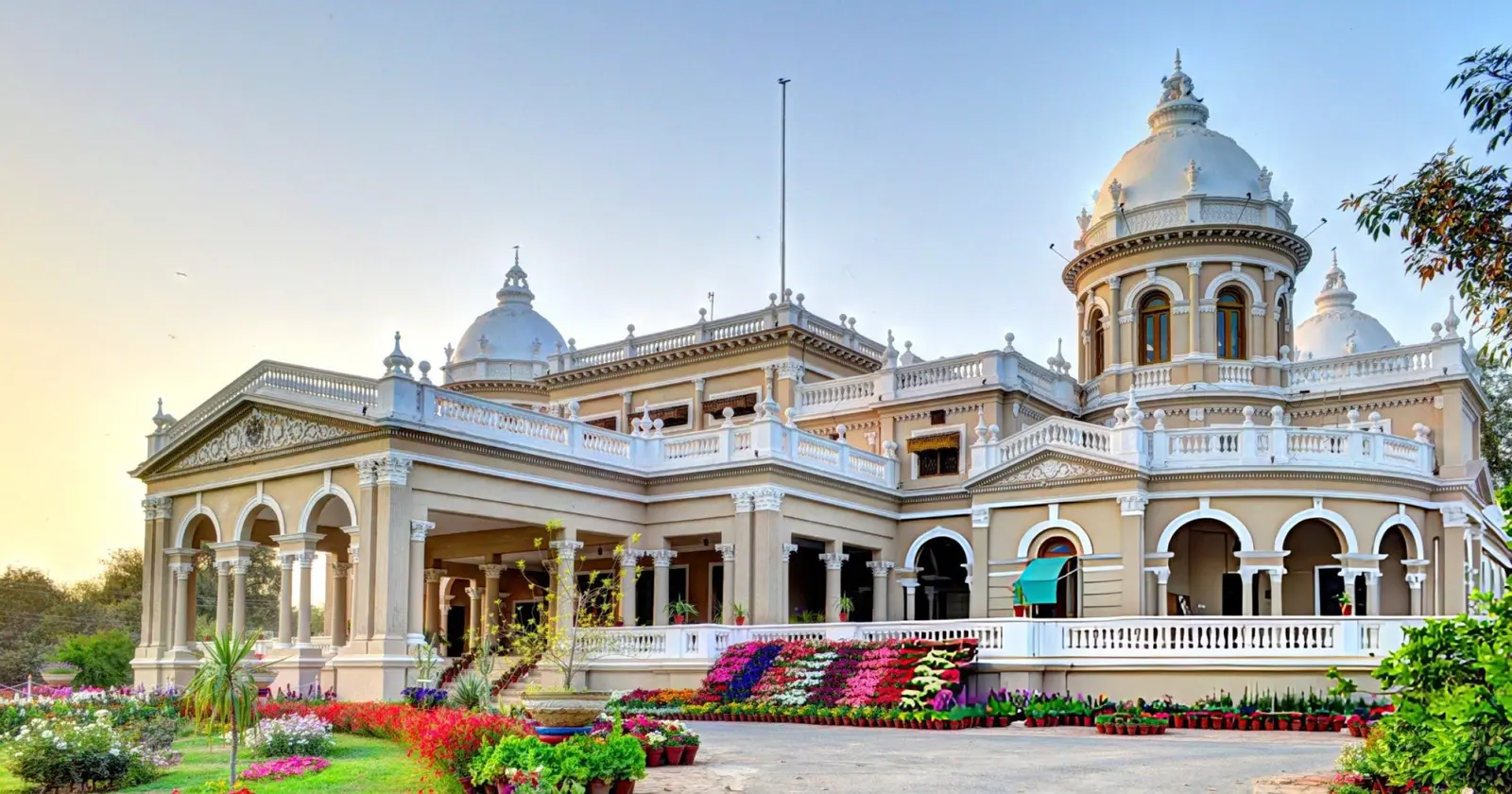
I found it by accident. I was walking the area around the Bahawalgarh Complex, trying to photograph the perimeter wall, when I turned a corner and there it was. A white-and-pastel palace with four round domes, Corinthian columns framing arched verandahs, and vines crawling up the facade like nature was slowly reclaiming it. The courtyard was overgrown. Paint was peeling in long strips. But through the decay, you could see exactly what this building used to be — and it was stunning.
Gulzar Mahal doesn't appear in most tourist itineraries. It isn't a museum. There's no ticket counter. You can't go inside. But if you're in Bahawalpur and you care even slightly about architecture or history, you should see it. Here's everything we know about the Palace of Flowers.
What Gulzar Mahal actually is
Gulzar Mahal is an early 20th-century royal palace in central Bahawalpur, about 2 km from Noor Mahal. The name translates as "Palace of Flowers" or "Rose Garden Palace" in Persian — a reference to the elaborate rose beds and ornamental gardens that once surrounded the building. According to some sources, it was also named after a wife of Nawab Bahawal Khan V.
It was built as a residence for the women of the royal household — specifically the wives and female relatives of the Nawab other than the queen. Think of it as the zenana wing of the Abbasi Nawabs' palace network. While Darbar Mahal handled state affairs and Nishat Mahal served as an additional domestic residence, Gulzar Mahal was the most intimate of the four palaces in the Bahawalgarh Complex — a family retreat with gardens, fountains, and surprisingly modern amenities.
The Punjab Tourism Development Corporation describes it as "a quiet ruin amid urban sprawl, a poignant reminder of Bahawalpur's faded glory." That's accurate. It's beautiful and it's heartbreaking in equal measure.
Quick reference
Names: Gulzar Mahal, Gulzar Palace, Palace of Flowers, Rose Palace
Built by: Nawab Sadiq Muhammad Khan V
Construction: 1906–1909
Location: Central Bahawalpur (~2 km from Noor Mahal)
Coordinates: 29.3947°N, 71.6975°E
Style: Indo-Saracenic with European/Italianate elements
Notable feature: First electrically wired building in Bahawalpur
Current state: Exterior viewing only, deteriorating, leased by armed forces
since 1966
The history: 1906–1909
Construction began in 1906 during the reign of Nawab Sadiq Muhammad Khan V — the last crowned Nawab of the Princely State of Bahawalpur. Wikipedia cites UNESCO's Cultural Expressions of South Punjab for these dates, and the TDCP listing confirms construction between 1906 and 1909.
The timing matters. This was the same building campaign that produced Darbar Mahal, Nishat Mahal, and Farrukh Mahal — all within the larger Bahawalgarh Palace Complex. The Nawabs of Bahawalpur were in the middle of a major modernisation drive. Other princely states across British India were doing the same thing: Mysore rebuilt its palace. Hyderabad had Falaknuma. Baroda was constructing Lakshmi Vilas. Bahawalpur answered with an entire complex of palaces in different styles.
What sets Gulzar Mahal apart from its siblings isn't scale — it's smaller than Darbar Mahal or Nishat Mahal. It's the technology. According to multiple sources cited on Wikipedia, Gulzar Mahal was reportedly the first building in all of Bahawalpur to have concealed electric wiring. Electricity came from a dedicated diesel-powered generator. The palace also had its own clean drinking water supply — a remarkable feature for early 20th-century Punjab, where most buildings relied on wells or hand-carried water.
These weren't just luxuries. They were statements. The Nawab was showing that Bahawalpur's royal household could match — or exceed — the modern amenities that British administrators enjoyed in their own residences. A palace with hidden wiring, indoor plumbing, and generator-backed electricity in 1909 Punjab was cutting-edge.
The post-independence decline
After Pakistan's creation in 1947, the princely state of Bahawalpur was eventually merged into the new country in 1955. The Nawab's palaces shifted from royal residences to government and military property. The armed forces took control of the Bahawalgarh Complex — including Gulzar Mahal — in 1966.
But unlike Darbar Mahal or Nishat Mahal, which the Army actively maintained and used for administrative purposes, Gulzar Mahal was largely abandoned. The rose gardens weren't tended. The fountains stopped working. The pastel interiors with their floral frescoes were left to the weather. Over decades, the building slipped into the state of romantic decay you'll see today — peeling plaster, cracked marble, vine-covered arches, a courtyard slowly being reclaimed by nature.
Architecture: domes, turrets, and hidden wiring
Gulzar Mahal's architectural style is Indo-Saracenic with strong European and Italianate influences. TDCP describes a "fusion of Indo-Islamic and European architectural elements," which is the diplomatic way of saying the Nawab's architects were pulling from every tradition they admired and finding a way to make it work.
The most distinctive external features are the four circular domes sitting atop round turrets, giving the building a silhouette you won't find on any other Bahawalpur palace. While Darbar Mahal and Nishat Mahal are more rectangular and grounded, Gulzar Mahal has curved facades that create a softer, almost romantic profile — fitting for a building that housed the Nawab's family.
The facade
The exterior uses a palette of white and pastel tones — a stark contrast to Nishat Mahal's red brick with white stucco. Corinthian columns frame arched verandahs along the front elevation. Carved brackets and ornate window screens (jali work) break up the European classicism with Indo-Islamic detailing. The overall impression is lighter and more delicate than the other palaces in the complex.
Internal layout
The TDCP and historical sources describe an interior divided into four suites, each comprising double rooms that open into a central corridor. Each suite included circular dressing rooms and adjoining washrooms — a level of domestic planning that shows real consideration for the women who'd actually live here.
The walls were lined with floral frescoes executed in pastel colours. TDCP notes that "traces of floral frescoes that once glowed under gas lamps" are still visible in some areas. The combination of gas lamp lighting, painted florals, and the rose gardens visible through every window must have created an extraordinary domestic environment for its time.
The wiring
Here's the detail that architectural historians find most interesting. Gulzar Mahal's electric wiring was concealed within the walls — not run along the surface, which was the standard practice in early 20th-century buildings. This required planning the electrical layout before construction, integrating conduits into the masonry. It's a small detail, but it tells you something about the ambition behind this building. The Nawab didn't want to retrofit modernity onto a traditional palace — he wanted it built in from the start.
The gardens that gave it its name
You can't talk about Gulzar Mahal without talking about the gardens. The name literally means "garden of flowers," and from every account, the gardens lived up to it.
The palace was surrounded by extensive rose beds and ornamental plantings. Fountains punctuated the garden layout. The Husain, Rehman, and Wescoat study of Mughal gardens (1996) references Gulzar Mahal's grounds as part of Bahawalpur's broader tradition of ornamental garden design — a tradition the Nawabs inherited from both Mughal and Central Asian influences.
TDCP's description of the gardens is worth quoting: "Once surrounded by rose beds and fountains that earned its name, it hosted intimate royal gatherings away from formal pomp." This was the social palace. While Darbar Mahal was for state business and formal audiences, Gulzar Mahal was where the family gathered for private events — garden parties among the roses under the Punjab sky.
Today, the gardens are overgrown. The fountains are silent. But the bones are there — you can still trace the original garden layout, and in certain seasons, flowers push through the neglect. It's a melancholy kind of beauty, but it's beauty nonetheless.
From royal residence to romantic ruin
TDCP doesn't sugarcoat Gulzar Mahal's current condition. They describe "peeling paint, cracked marble, and overgrown courtyards that feel frozen in the 1940s." And that's exactly what you'll find.
Unlike Noor Mahal, which the Punjab government restored and opened as a museum, or Darbar Mahal, which the Army maintains for operational use, Gulzar Mahal has had no serious restoration effort. The building is structurally intact — the walls, domes, and turrets still stand — but the decorative elements are deteriorating. Stucco is crumbling. The floral frescoes are fading. Plaster falls in sheets every monsoon season.
Some heritage advocates have called for the palace to be declared a national heritage site. A 2004 article in Dawn newspaper reported calls from local civil society to declare Bahawalpur's palaces as protected national heritage. As of 2026, that hasn't happened for Gulzar Mahal.
But there's an argument that the decay is part of the experience. TDCP describes it as offering "a raw, melancholic beauty" and calls it "the perfect 'secret palace' stop for anyone chasing authentic, unpolished heritage." I'd agree. If you want to see a perfectly restored museum palace, go to Noor Mahal. If you want to feel something — to actually sense what the passage of time does to grandeur — come to Gulzar Mahal.
How to visit Gulzar Mahal today
Access and location
Gulzar Mahal is in central Bahawalpur, roughly 2 km from Noor Mahal. It's significantly more accessible than Nishat Mahal — you're not dealing with a military compound perimeter here. You can view the exterior and surrounding grounds freely from dawn to dusk. There's no entry fee.
A Careem or InDriver ride from anywhere in Bahawalpur costs PKR 200–400. Most rickshaw drivers know the location. If you're already visiting Noor Mahal, it's a quick detour — well worth the 10-minute ride.
Interior access isn't available. The building has been leased by the armed forces since 1966 and its deteriorated state makes interior access risky regardless. TDCP recommends allowing 30–45 minutes for an exterior visit — enough time to walk the perimeter, photograph the facade, and explore the overgrown garden layout.
Combining with other sites
Gulzar Mahal fits perfectly into a Bahawalpur palace day. Start at Noor Mahal (the best-restored, open to public), then drive to Gulzar Mahal (2 km, 10 minutes), continue to the Bahawalgarh Complex area for exterior views of Darbar Mahal and Nishat Mahal, and end the day at the Abbasia Mosque. If you've got a full weekend, add the Derawar Fort road trip the next day.
Don't leave without eating properly — the Bahawalpur food guide covers where locals actually go.
When to go
October through March. Bahawalpur sits in southern Punjab where summer temperatures routinely cross 40°C. TDCP specifically recommends the same October–March window for Gulzar Mahal. Early morning gives you the best light for exterior photography and the most comfortable conditions.
Photography tips
Gulzar Mahal is arguably the most photogenic palace in Bahawalpur — and that includes Noor Mahal. The contrast between the elegant architecture and the botanical reclamation happening around it creates something genuinely striking. Shoot the vine-covered arches, the peeling stucco revealing brick underneath, and the garden paths disappearing into overgrowth. Golden hour light through the Corinthian columns is particularly good.
Getting to Bahawalpur
By air: Bahawalpur Airport has limited domestic flights — check current
schedules
By train: Bahawalpur Junction connects to Lahore, Multan, and Karachi via
Pakistan Railways
By road: About 5–6 hours from Lahore via N-5 highway, or 2 hours from
Multan
Local transport: Careem, InDriver, or local rickshaw. PKR 200–400 from
anywhere in the city to Gulzar Mahal.
Frequently asked questions
Can you visit Gulzar Mahal?
Only the exterior. Gulzar Mahal sits in central Bahawalpur and you can view the facade and surrounding grounds from dawn to dusk, free of charge. Interior access isn't available — the building has been leased by the armed forces since 1966 and is in a deteriorated state. TDCP recommends allowing 30–45 minutes for an exterior visit.
When was Gulzar Mahal built?
Construction started in 1906 during the reign of Nawab Sadiq Muhammad Khan V and was completed in 1909. UNESCO's Cultural Expressions of South Punjab and TDCP both confirm these dates. The palace was part of the same building campaign that produced Darbar Mahal, Nishat Mahal, and Farrukh Mahal.
What does Gulzar Mahal mean?
"Gulzar" means "garden of flowers" or "rose garden" in Persian/Urdu. The palace was named for its surrounding rose beds and ornamental gardens. TDCP translates it as "Palace of Flowers." Some sources say it was also named after a wife of Nawab Bahawal Khan V.
Why is Gulzar Mahal historically significant?
It was reportedly the first building in Bahawalpur to have concealed electric wiring, powered by a diesel generator. It also had a dedicated clean water supply — both remarkable for early 20th-century Punjab. Architecturally, it represents the Nawabs' effort to modernise their residences while preserving Indo-Islamic design traditions.
What's the difference between Gulzar Mahal and Noor Mahal?
Noor Mahal is a grand 19th-century palace built in 1872 in Italian-Corinthian style — it's Bahawalpur's most famous landmark and is open as a museum. Gulzar Mahal is smaller, built 30+ years later in 1906–1909, in a more restrained Indo-Saracenic style. Noor Mahal is maintained; Gulzar Mahal stands in romantic decay. They're only about 2 km apart.
How do I get to Gulzar Mahal?
Gulzar Mahal is in central Bahawalpur, roughly 2 km from Noor Mahal. A Careem or InDriver ride costs PKR 200–400 from anywhere in the city. If you're visiting Noor Mahal already, it's a quick 10-minute detour. Tell your driver "Gulzar Mahal" — most locals know it.
What's the best time to visit Gulzar Mahal?
October through March. Summer temperatures in Bahawalpur push past 40°C regularly. Winter months offer mild conditions between 20–30°C. Early morning gives the best light for photography and fewer people. Combine it with Noor Mahal and Darbar Mahal for a full palace day.
Related articles