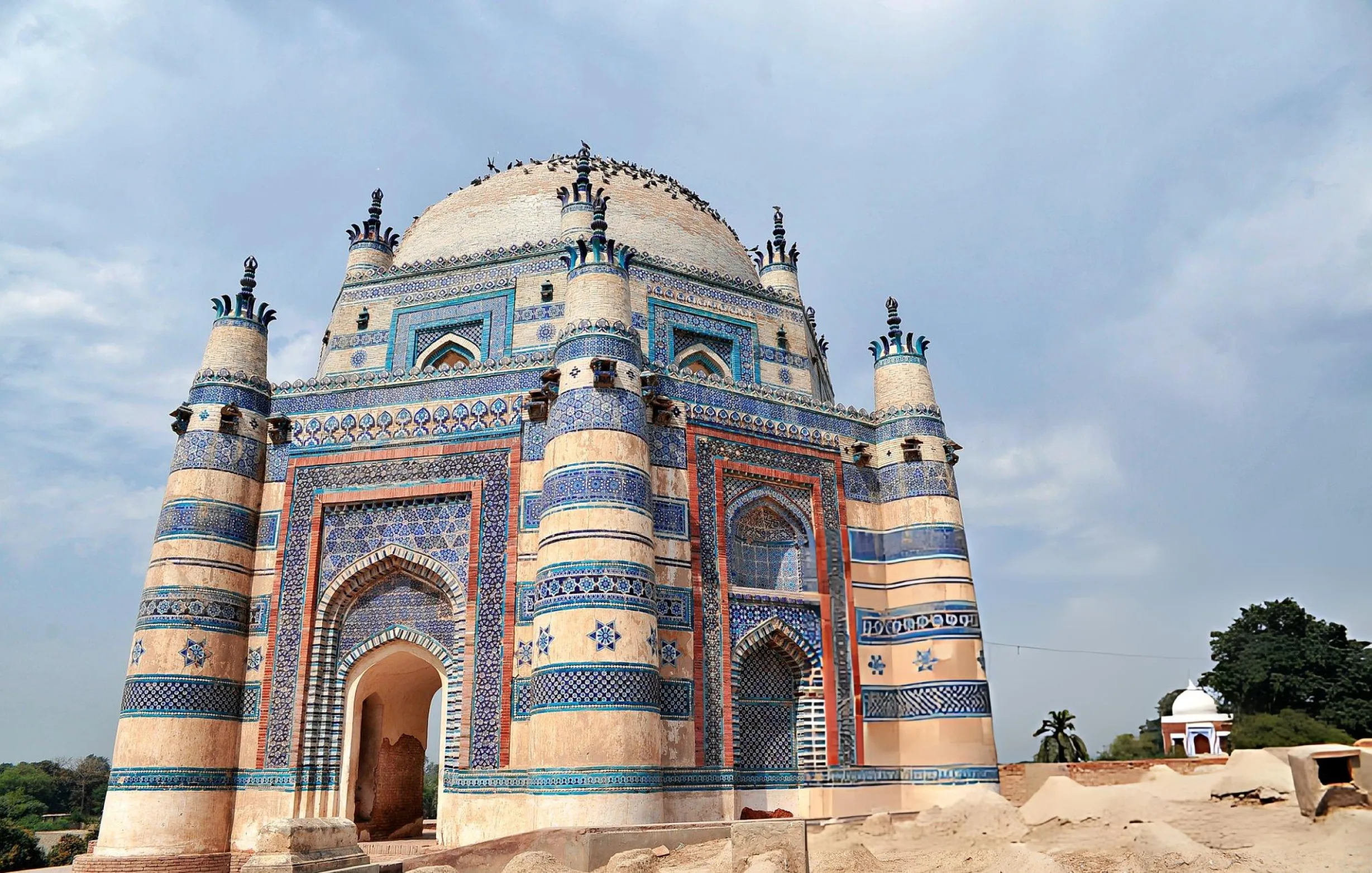
You don't expect to find world-class architecture in a small Punjabi town surrounded by cotton fields and canal roads. But Uch Sharif isn't a normal small town. People have lived here for over two thousand years. Alexander the Great might've founded it. Sufi scholars from Bukhara and Persia settled here when they fled Mongol invasions. And sometime around 1494, someone built a mausoleum here that would make you stop mid-conversation and stare.
I'm talking about the Tomb of Bibi Jawindi. If you've seen photos of Uch Sharif — the kind with bright blue tiles against a dusty desert sky — you've seen this building. It's the one that looks like it was cut in half with a knife. Roughly half the structure was washed away by floods in the early 1800s, leaving behind a cross-section that exposes the interior: carved timber, decorative plasterwork, two stories of circular chambers. It looks simultaneously ancient and impossibly modern.
This tomb sits at the heart of the Uch Monument Complex, a group of five structures that Pakistan submitted to UNESCO's tentative World Heritage list back in January 2004. Twenty-two years later, they're still waiting. Here's everything you should know before you make the drive from Bahawalpur.
Why this tomb matters
Three reasons people care about the Tomb of Bibi Jawindi, and they're all different.
First, there's the architecture. This is a textbook example of the southern Punjab funerary style — domed tomb on an octagonal base, richly decorated with blue-and-white faience mosaic tiles. The UNESCO tentative list submission describes the design as three-tiered: an octagonal base supporting a zone of transition, topped by a dome. Eight tapering turrets anchor the corners. Every surface was once covered in geometric and floral tilework imported from nearby Multan.
Second, there's the history. Bibi Jawindi was the great-granddaughter of Jahaniyan Jahangasht, one of the most powerful Suhrawardiyya Sufi saints in medieval Pakistan. Her tomb was built around 1494 during the Langah Sultanate period — a time when Uch was a metropolitan centre of religious scholarship, attracting mystics and intellectuals from across Central Asia.
Third — and this is what draws the photographers — there's the ruin itself. When the floods hit in the early 19th century, they didn't just damage the tomb. They sliced it open. What you see today is the original three-dimensional form exposed in cross-section, like a dollhouse with one wall removed. The World Monuments Fund describes the scene: "half-arches and exposed ceramic cores of the ruins rise dramatically against the sandy desert backdrop, encircled by a verdant grove of palm and mango trees."
That combination — turquoise tiles, dramatic ruin, Sufi heritage, desert setting — makes Bibi Jawindi's tomb one of the most striking historic buildings in all of Pakistan.
Quick reference
Names: Tomb of Bibi Jawindi, Bibi Jawindi Mausoleum, Bibi Jawindi Shrine
Built: c. 1494 (Langah Sultanate period)
Built for: Bibi Jawindi, great-granddaughter of the Sufi saint Jahaniyan
Jahangasht
Location: Uch Sharif, Bahawalpur District, Punjab — 84 km from Bahawalpur
city
Coordinates: 29.24086°N, 71.05244°E
Style: Southern Punjab funerary architecture with Multan-imported tilework
UNESCO status: On Pakistan's tentative list since January 30, 2004 (Ref.
1883)
WMF Watch: Listed in 1996, 2000, and 2002
Current state: Partially ruined — roughly half destroyed by early 19th-century
floods
Who was Bibi Jawindi?
Details about Bibi Jawindi herself are thin. Most of what we know comes through her lineage rather than her own biography — and that lineage is significant.
She was the great-granddaughter of Jahaniyan Jahangasht (1307–1383), a towering figure in Suhrawardiyya Sufism. Jahangasht — whose name roughly translates as "world traveller" — was one of the most influential Sufi saints in the Multan-Uch region. He built the first of the three major domed tombs in the Uch Monument Complex for his teacher, Sheikh Baha'al-Halim. The Suhrawardiyya order, which Bahauddin Zakariya had established in nearby Multan in the early 1200s, dominated the spiritual landscape of southern Punjab for centuries.
Bibi Jawindi continued that tradition. She's remembered as a Sufi premier of the Suhrawardiyya order — not just a descendant of saints, but a spiritual figure in her own right. In the patriarchal world of medieval Punjab, that's worth noting. Uch was unusual in this respect. The town's shrines and monuments honour "pious daughters and wives" alongside the male saints. Wikipedia's entry on Uch cites historians who note that the region's funerary monuments commemorate women of the Sufi lineage as prominently as the men.
When Bibi Jawindi died, her followers built her a mausoleum that matched — and some say surpassed — the tombs of her male predecessors. The architect who designed it was so skilled that he received his own tomb next door. That architect's mausoleum, known as the Tomb of Ustead ("Master"), stands alongside Bibi Jawindi's as part of the same UNESCO-nominated complex.
Architecture: the half-tomb
Start with what was. The original Tomb of Bibi Jawindi was a fully intact three-tier octagonal structure: a broad base, a narrower transition zone above it, and a dome crowning the top. Eight engaged turrets tapered upward from the octagonal base's corners, giving the building a vertical rhythm that made it look taller than it actually was.
The base walls tapered inward slightly. Inside, the floor plan was circular — thick angled walls converting the exterior octagon into a round interior space that rose through two stories to the dome above. This is a clever trick of the southern Punjab style. From outside, you see angular geometry and sharp corners. Step inside and you're in a smooth, circular chamber that feels twice as spacious as it should.
Now for the decoration. The UNESCO submission describes "carved timber, cut and moulded brick, and blue and white faience mosaic tiles." Those tiles were the building's signature. Imported from Multan's tile-making workshops, they covered the exterior in geometric patterns and floral motifs. The World Monuments Fund calls them "cerulean blues and luminous whites." Against the brown-yellow of the surrounding desert, the effect must've been spectacular — like finding a turquoise jewel in the sand.
Interior surfaces featured painted plasterwork, Islamic calligraphy, and timber carvings. The floor held the grave of Bibi Jawindi herself. A perimeter compound enclosed additional cemented graves — followers and family members who wanted to rest near the saint.
Then came the water.
Flooding in the early 19th century — most sources say around 1817, though the World Monuments Fund dates the initial event to 1820 — washed away roughly half the structure. The Chenab River, which once flowed much closer to Uch than it does today, broke its banks and tore through the monument complex. What's left is the building's most famous feature: a cross-section that exposes the construction method, the layered decoration, and the circular interior chamber as if someone peeled away the outer wall.
Locals call it the "half-tomb." Photographers call it a goldmine. Conservation experts call it an emergency. The exposed surfaces have been subject to two centuries of wind erosion, salt infiltration, and humidity damage. Some well-intentioned but clumsy repair work — using Portland cement instead of traditional lime-based materials — has actually made things worse by trapping moisture inside the historic brickwork.
The Uch Monument Complex
Bibi Jawindi's tomb doesn't stand alone. It's part of a cluster of five monuments that Pakistan submitted to UNESCO together in 2004 under the full title: "Tomb of Bibi Jawindi, Baha'al-Halim and Ustead and the Tomb and Mosque of Jalaluddin Bukhari."
Here's what's in the complex:
Tomb and Mosque of Jalaluddin Bukhari (14th century). The oldest structures in the group. Jalaluddin Surkh-Posh Bukhari arrived in Uch from Bukhara in 1244–45, fleeing the Mongol invasions. He became the town's most celebrated saint. His brick-built tomb measures 18 by 24 metres with carved wooden pillars supporting a flat roof, decorated with glazed tiles in floral and geometric designs. The attached mosque has 18 wooden columns and measures 20 by 11 metres.
Tomb of Baha'al-Halim (14th century). The first of the three domed tombs. Jahaniyan Jahangasht built this for his teacher, Sheikh Baha'al-Halim. Like Bibi Jawindi's tomb, it follows the octagonal-base-and-dome pattern with blue-and-white tilework. It, too, was severely damaged by the 19th-century floods — its interior is now partially exposed, giving visitors a rare look at medieval construction techniques.
Tomb of Bibi Jawindi (c. 1494). The largest and most decorated of the three domed tombs. The star of the complex.
Tomb of Ustead (c. 1494). Built for the architect — the "Ustead" or master builder — who designed Bibi Jawindi's tomb. The fact that the architect got his own mausoleum tells you how much the community valued his work. This tomb follows similar octagonal geometry but on a smaller scale.
Together, these structures span roughly 200 years of construction (14th through 16th centuries) and represent the most concentrated collection of southern Punjab's distinctive tile-decorated funerary architecture. The compound is surrounded by approximately 1,400 graves and sits at the old city's western edge, connected to the rest of Uch by narrow lanes and winding bazaars.
Seventeen tiled funerary monuments in total are scattered around Uch Sharif, but this cluster of five at the western edge is the core — and the one UNESCO cares about. The nomination cites criteria (ii), (iv), and (vi): interchange of human values, outstanding architectural typology, and association with events of universal significance.
Uch Sharif: 2,300 years of history
You can't write about Bibi Jawindi's tomb without writing about the town that holds it. Uch Sharif is one of the oldest continuously inhabited cities in Punjab, and its history reads like a compressed timeline of the entire subcontinent.
The origin story is wild. According to British archaeologist Alexander Cunningham, Uch was founded in 325 BCE by Alexander the Great himself as the city of Alexandria on the Indus. The city sat at the confluence of the Chenab and Indus rivers and was reportedly settled by colonists from the Greek region of Thrace. The rivers have since shifted course — the confluence is now about 40 km southwest at Mithankot — but the town stayed put.
Muhammad bin Qasim conquered Uch in 712 CE. The Ghaznavids rolled through in 1006. By the 1200s, Uch had become the capital of a breakaway sultanate under Nasir ad-Din Qabacha and a major centre of Islamic scholarship — the renowned Persian historian Minhaj-i-Siraj ran one of the city's madrasas. Genghis Khan's forces battled the last Khwarazmian sultan here in 1224. Mongol raids hit in 1245, 1258, 1304, and 1305.
Through all of it, Uch kept attracting Sufi scholars. Jalaluddin Bukhari arrived from Central Asia in 1244. The Suhrawardiyya order took root. The Qadiriyya order established a khanqah in the mid-1400s. By the Mughal period, Uch was a recognized district of Multan province, listed in Akbar's Ain-i-Akbari. The great Punjabi Sufi poet Bulleh Shah was born here in 1680. Guru Nanak, founder of Sikhism, visited in the early 1500s.
The city eventually became part of the Bahawalpur princely state after the Abbasi family declared independence in 1748. When Pakistan was founded in 1947, Uch had maybe 2,000–3,000 people. Today the city's population is around 98,000, but its historical and spiritual importance still far outweighs its size.
Three distinct quarters divide the old town: Uch Bukhari (named for saints from Bukhara), Uch Gilani (for saints from Persia), and Uch Mughlia (for descendants of Mongol settlers). That cosmopolitan DNA — Central Asian, Persian, Turkic, Mongol, local Punjabi — is written into the architecture, the tombstones, and the food you'll eat at roadside stalls off the main bazaar.
Conservation: saving what's left
The Uch Monument Complex has been on the international conservation radar for nearly three decades. It hasn't been enough.
The World Monuments Fund placed Uch on its Watch list three times: 1996, 2000, and 2002. American Express partnered with WMF to provide financial assistance for conservation. Pakistan's Conservation and Rehabilitation Center (CRC) partnered with international conservators to develop preservation strategies. In 1999, CRC invited international heritage bodies to assess the damage and plan interventions.
The problems are layered and interconnected. Humidity from the nearby canal system seeps into the brickwork. Salt infiltration crystallises inside the walls, causing them to crumble from within. Wind erosion from the Cholistan Desert scours exposed surfaces. And some previous repair attempts used Portland cement — a modern material that's incompatible with the original lime-and-brick construction. Cement traps moisture instead of allowing it to evaporate, accelerating the very deterioration it was meant to stop.
The most significant recent development came in 2018, when the World Bank approved a $500 million loan to the Punjab Government specifically for restoring historical monuments across the province. The Tomb of Bibi Jawindi was among the named sites. The Dawn newspaper reported the announcement on April 18, 2018.
Whether that money has translated into visible progress at Uch is a different question. Some scaffolding and protective awnings have appeared around the monuments. But the core challenge hasn't changed: these are 500-year-old structures made of materials and techniques that modern builders don't always understand. Genuine conservation requires specialists who can work with traditional glazed tiles, lime-based mortars, and centuries-old timber framing. That expertise is rare even in countries with much larger conservation budgets than Pakistan.
UNESCO's tentative list isn't the same as full inscription — and the gap matters. Tentative-list sites don't receive the funding, monitoring, or global visibility that inscribed World Heritage Sites get. Twenty-two years on the waiting list is a long time for a structure that's actively disintegrating.
How to visit from Bahawalpur
Uch Sharif is 84 km west of Bahawalpur — about 90 minutes by car on a decent road through flat agricultural country. You'll pass cotton fields, canal crossings, and small market towns. It's not a scenic drive, but it's easy.
Getting there. Your best option is a hired car from Bahawalpur. A full-day hire (with driver) for an Uch Sharif day trip costs PKR 4,000–6,000 depending on the car. Public transport exists — Daewoo and local buses run from Bahawalpur to Ahmadpur East, and then you'd hire a rickshaw for the remaining stretch — but it turns a 90-minute drive into a 3-hour ordeal. Don't do that unless you genuinely enjoy logistics puzzles.
The route. Head west from Bahawalpur on the Ahmedpur–Uch road. The Uch Monument Complex is at the western edge of the old town. Ask any local for "Bibi Jawindi ka mazar" or just "monument complex." Everyone knows it.
What to see. Start at Bibi Jawindi's tomb — it's the most visually striking. Walk the compound to see the Tomb of Baha'al-Halim and the Tomb of Ustead nearby. Then head to the Tomb and Mosque of Jalaluddin Bukhari, which is the town's spiritual anchor. The shrine of Jalaluddin Bukhari hosts urs festivals that draw thousands of pilgrims — if you time your visit right, you'll see Uch at its most lively.
Time needed. Allow 2–3 hours for the monument complex and a quick walk through the old bazaars. If you're combining it with the Bahawalpur to Derawar Fort road trip, build in a full day.
When to go. October through March. Uch has an arid climate — identical to Multan's. Summer highs regularly break 45°C. The record is 52°C. Winter months are comfortable at 15–25°C, and early morning light makes the blue tiles glow against the brown landscape.
Food. Eat before you come or expect basic roadside options. Uch doesn't have restaurants in the tourist sense. The bazaar has chai stalls and simple rice-and-dal spots. For a proper meal, stop in Ahmadpur East on the way back — or plan to eat in Bahawalpur where the options are much better. Our Bahawalpur food guide covers the essentials.
What to bring. Water (at least two litres per person in winter, more in shoulder season). Sunscreen. A hat. Comfortable walking shoes — the compound ground is uneven. Camera with a wide-angle lens if you're serious about photography. There's no shade at the monuments themselves.
Combine with. If you're making the trip already, don't just see Bibi Jawindi and leave. The Lal Suhanra National Park is in the same direction. Derawar Fort is further south in Cholistan. And back in Bahawalpur, you've got Noor Mahal, Darbar Mahal, Gulzar Mahal, and the Abbasi Mosque to fill out a multi-day heritage itinerary.
Bottom line: The Tomb of Bibi Jawindi is the single most important heritage site in Bahawalpur District that most tourists never see. It's 84 km from the city, partially ruined, and has been waiting for UNESCO inscription for over two decades. But those blue tiles against the desert sky — there's nothing else quite like it in Pakistan. Make the drive.
Frequently asked questions
Is Uch Sharif worth visiting from Bahawalpur?
The 84 km drive takes about 90 minutes each way. Once there, you'll find five UNESCO-tentative monuments including the Tomb of Bibi Jawindi, the Shrine of Jalaluddin Bukhari, and the Tomb of Baha'al-Halim. Most visitors spend 2–3 hours exploring. Combine it with the Bahawalpur to Derawar Fort road trip for a full heritage day.
What is the Tomb of Bibi Jawindi famous for?
Three things: its bright blue-and-white glazed faience mosaic tiles, its octagonal three-tiered architecture with a dome, and its dramatic half-ruin. Roughly half the structure was washed away in an 1817 flood, exposing the interior and creating one of the most photographed heritage sites in Punjab. It's been on UNESCO's tentative World Heritage list since January 2004.
Who was Bibi Jawindi?
Bibi Jawindi was the great-granddaughter of Jahaniyan Jahangasht (1307–1383), a revered Suhrawardiyya Sufi saint and one of the most prominent spiritual figures in medieval southern Punjab. Her tomb was built around 1494 by her followers. She's remembered as a Sufi premier of the Suhrawardiyya order.
Is the Tomb of Bibi Jawindi a UNESCO World Heritage Site?
Not yet. It's on UNESCO's tentative list — submitted by Pakistan's Department of Archaeology and Museums on January 30, 2004, under criteria (ii), (iv), and (vi). It was submitted alongside four companion monuments in the Uch Monument Complex. As of 2026, it hasn't been formally inscribed as a full World Heritage Site.
What happened to the Tomb of Bibi Jawindi?
Flooding in the early 19th century (around 1817–1820) washed away roughly half the structure. What remains shows the original three-tier design — octagonal base, transition zone, and dome — plus exposed interior walls decorated with carved timber and tile work. Humidity, salt infiltration, wind erosion, and some inappropriate cement repairs have further damaged it over the centuries.
How old is Uch Sharif?
Uch Sharif may date back to 325 BCE, when Alexander the Great possibly founded it as Alexandria on the Indus. British archaeologist Alexander Cunningham supported this identification. The city has been continuously inhabited for over 2,300 years.
What's the best time to visit Uch Sharif?
October through March. Uch has an arid climate — summer temperatures regularly exceed 40°C and can hit 50°C. Winter months are comfortable at 15–25°C. Early morning visits avoid the heat and give the best photography light. During urs festivals at the Jalaluddin Bukhari shrine, the town is at its most vibrant.
Related articles
- Bahawalpur Royal Palaces Guide
- Complete Guide to Noor Mahal Bahawalpur
- Darbar Mahal Bahawalpur: Complete Visitor's Guide
- Abbasi Mosque: History, Architecture & Visitor Guide
- Gulzar Mahal Palace Bahawalpur: The Rose Palace Guide
- Derawar Fort Cholistan: Complete Planning Guide
- Bahawalpur to Derawar Fort Road Trip: Complete Itinerary